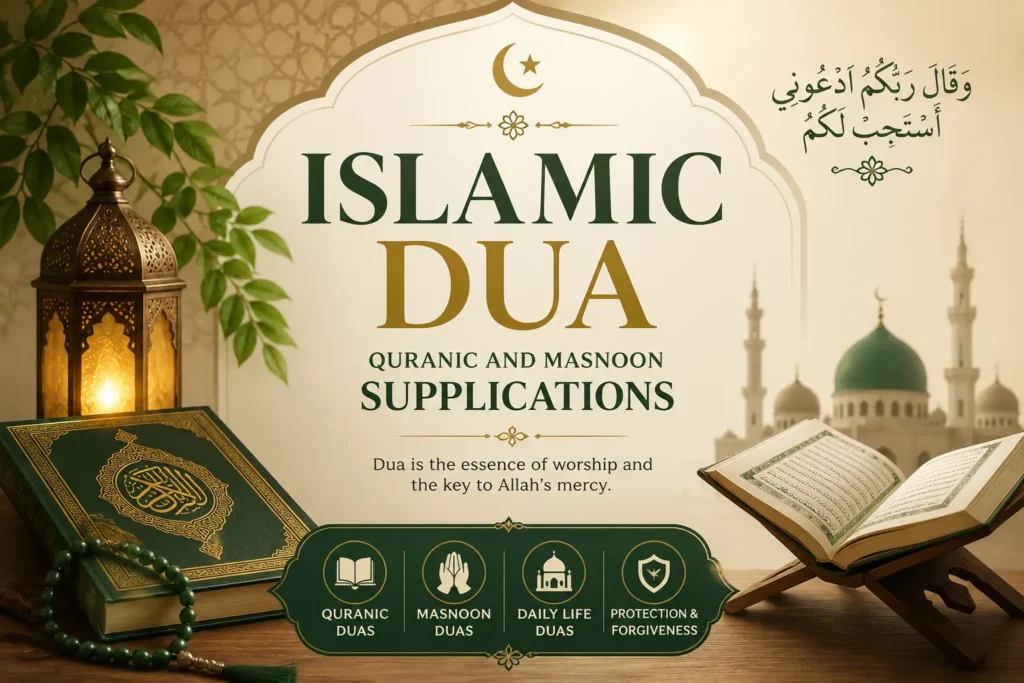
Dua allows a Muslim to approach Allah with a request, hope, concern or personal need. It may be part of worship or connected with everyday circumstances. A person can ask Allah for guidance, forgiveness, safety, halal provision, family wellbeing or assistance during a challenging situation.
The Quran highlights the closeness of Allah to those who call upon Him. Surah Al-Baqarah 2:186 is a key reference when considering the importance of dua in Islam.
- How can you make use of special times for Dua?
A Muslim can make Dua whenever they need to, while also taking advantage of times and situations in which supplication is particularly encouraged in Islamic teachings. The important thing is to keep turning to Allah rather than restricting Dua to only one occasion.
- Is it appropriate to raise your hands while making Dua?
Yes, raising the hands is reported in supplication in the Sunnah. One narration records the Prophet ﷺ facing the Qiblah and raising his hands while asking Allah to guide the people of Daws. � Sunnah
- What can you do when you want Allah’s help during a hardship?
Bring the problem to Allah through Dua instead of losing hope. Ask for relief, guidance and a beneficial outcome, then continue taking the appropriate steps in your situation. Keep asking Allah even when the answer is not immediate
- What is a simple way to prepare before making Dua?
Take a moment to settle your mind and remember Allah before making your request. Praise Him, send blessings upon Prophet Muhammad ﷺ, and then explain what you are asking for. This gives the supplication a respectful beginning
- How do you make Dua when you have something important to ask Allah?
Start by turning your attention towards Allah and speak about your need honestly. You can ask Him for what you need in your own words, while keeping the request permissible and approaching Him with humility and hope.
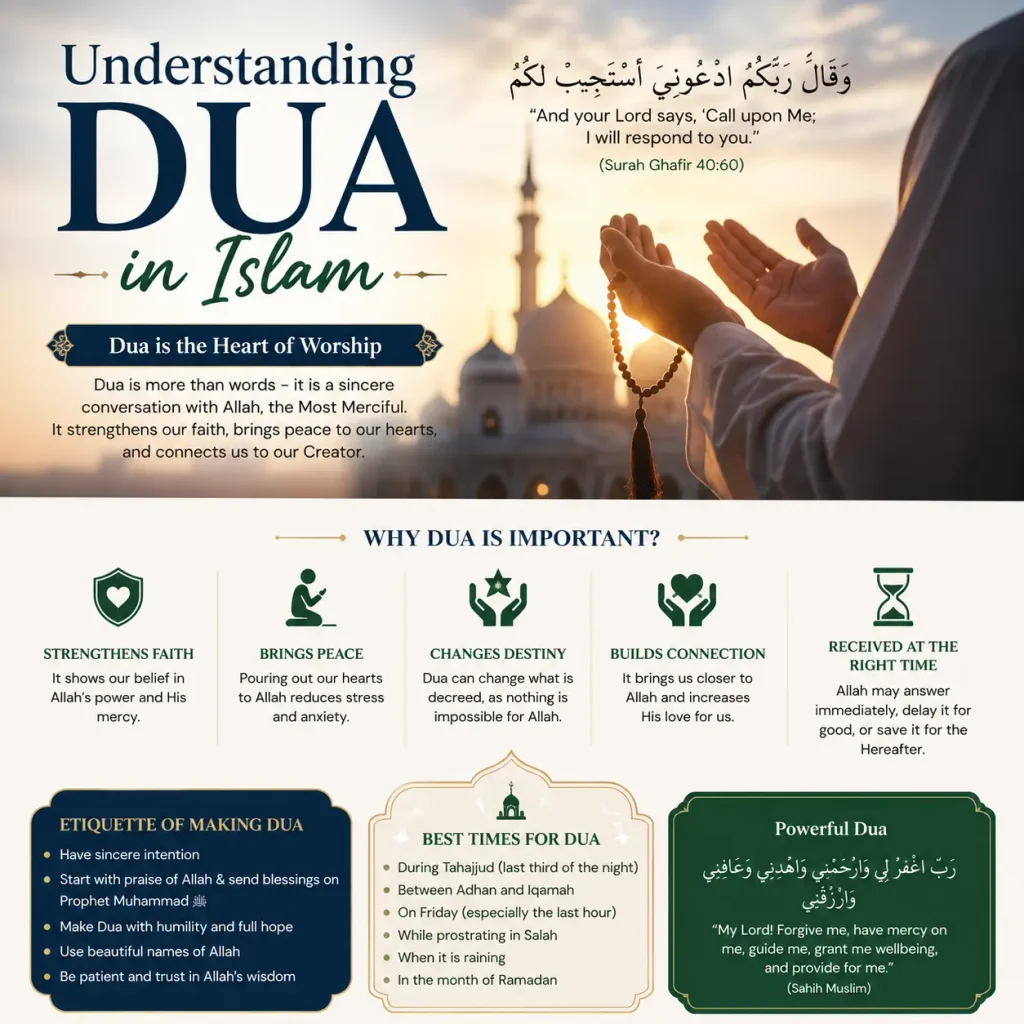
Understanding Dua in Islam
Dua is not simply something that a person memorizes and repeats. It reflects reliance upon Allah and gives a believer an opportunity to seek what is beneficial.
Some supplications are found in the Quran, whereas others were conveyed through the Sunnah of Prophet Muhammad ﷺ. A Muslim may also speak to Allah personally when asking for lawful needs.
For an Islamic resource to remain clear, these different types should be identified rather than presented as though they all have the same source.
Quranic Supplications
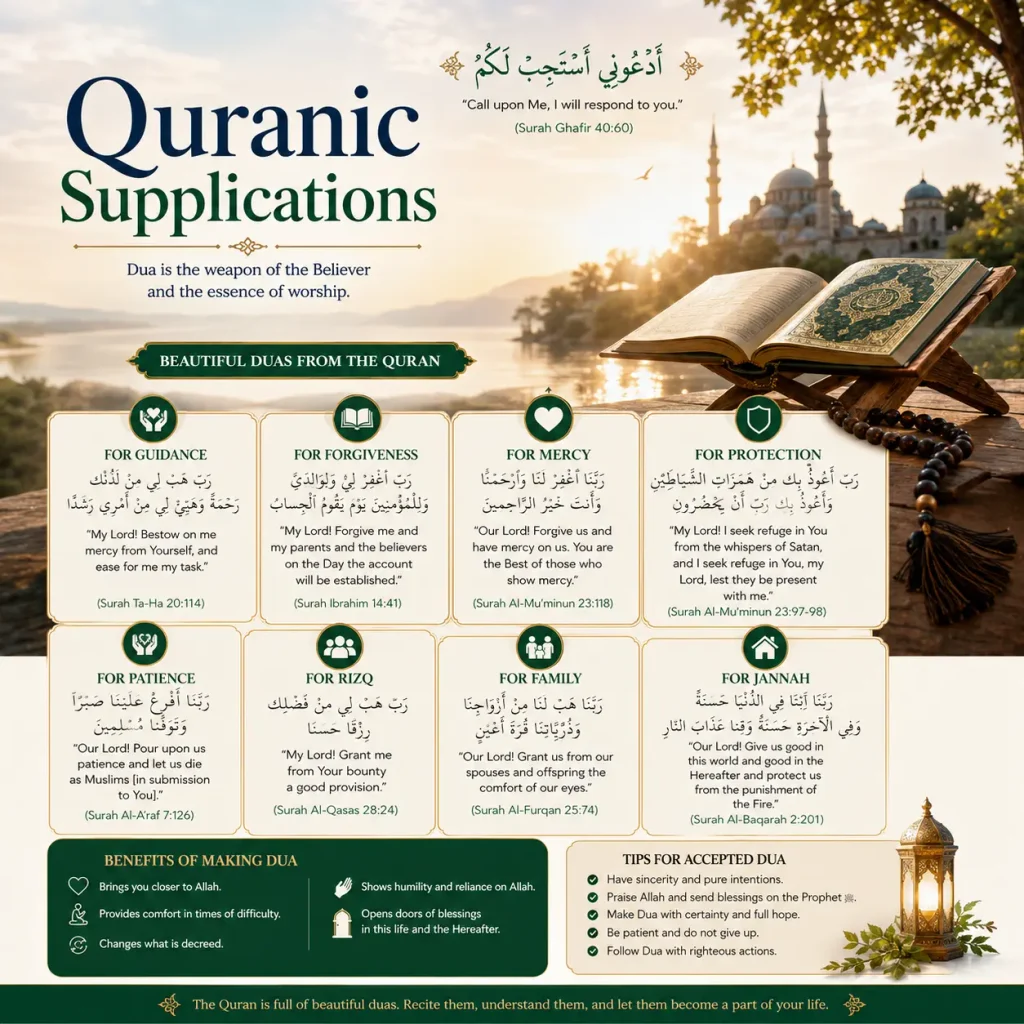
The Quran records prayers associated with prophets and righteous believers. Their themes include repentance, mercy, direction, knowledge, family and goodness in the Hereafter.
Reading these passages alongside their translations helps readers grasp the request being made. Providing the relevant verse reference also allows the original passage to be located and examined.
Masnoon Supplications
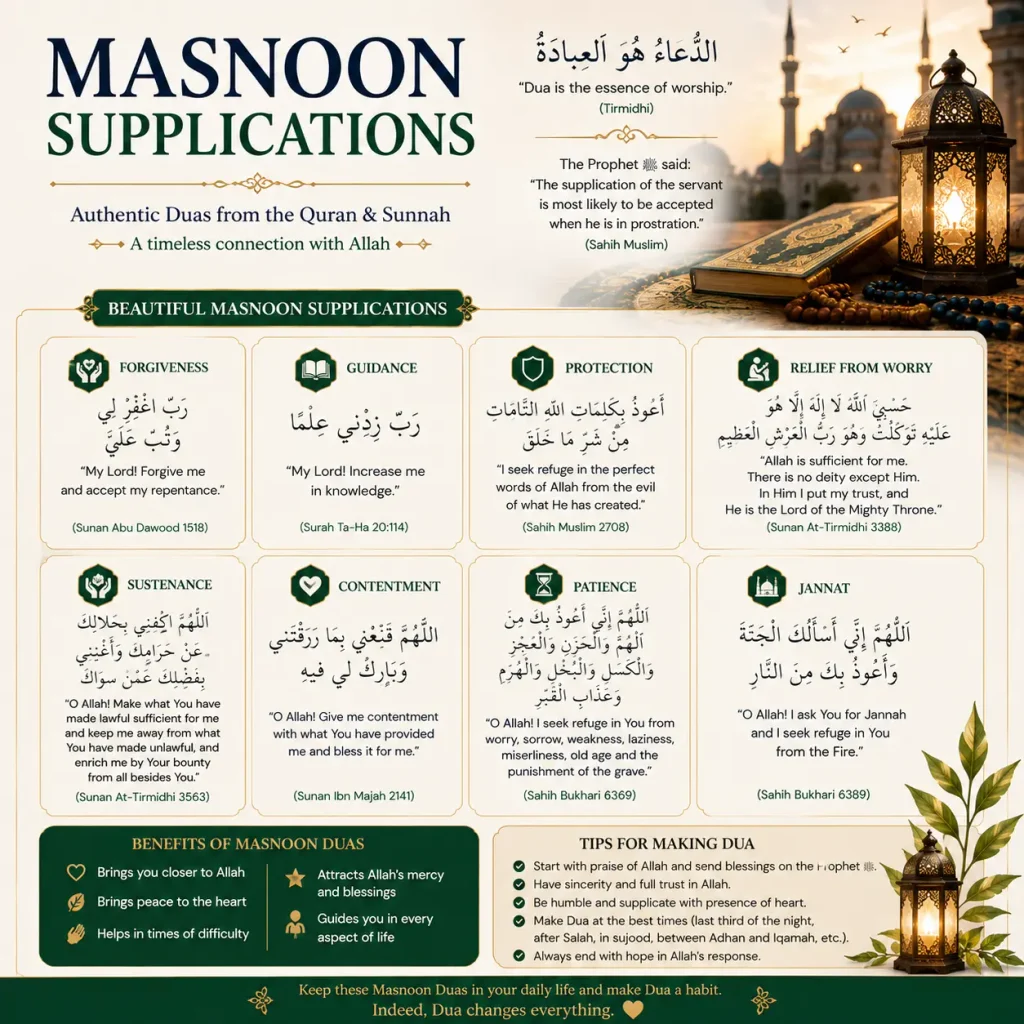
The Sunnah contains many prayers related to a Muslim’s daily life. Some belong to worship, while others apply to ordinary circumstances.
Prophetic supplications cover subjects such as eating, sleeping, travelling, entering or leaving places, seeking pardon and asking Allah for protection.
Collections based on Hisnul Muslim commonly arrange these prayers according to different situations and include references to their Islamic sources.
Daily Islamic Duas
Someone looking for a dua often has a particular circumstance in mind. Arranging the material by occasion can therefore make a collection easier to navigate.
A website may divide its material into subjects such as:
- Waking up
- Going to sleep
- Eating and drinking
- Leaving the home
- Entering the home
- Going to the mosque
- Leaving the mosque
- Wudu
- Travelling
- Returning from a journey
- Acts of worship
This type of arrangement is also used by established dua libraries, although the exact categories and organization differ between resources.
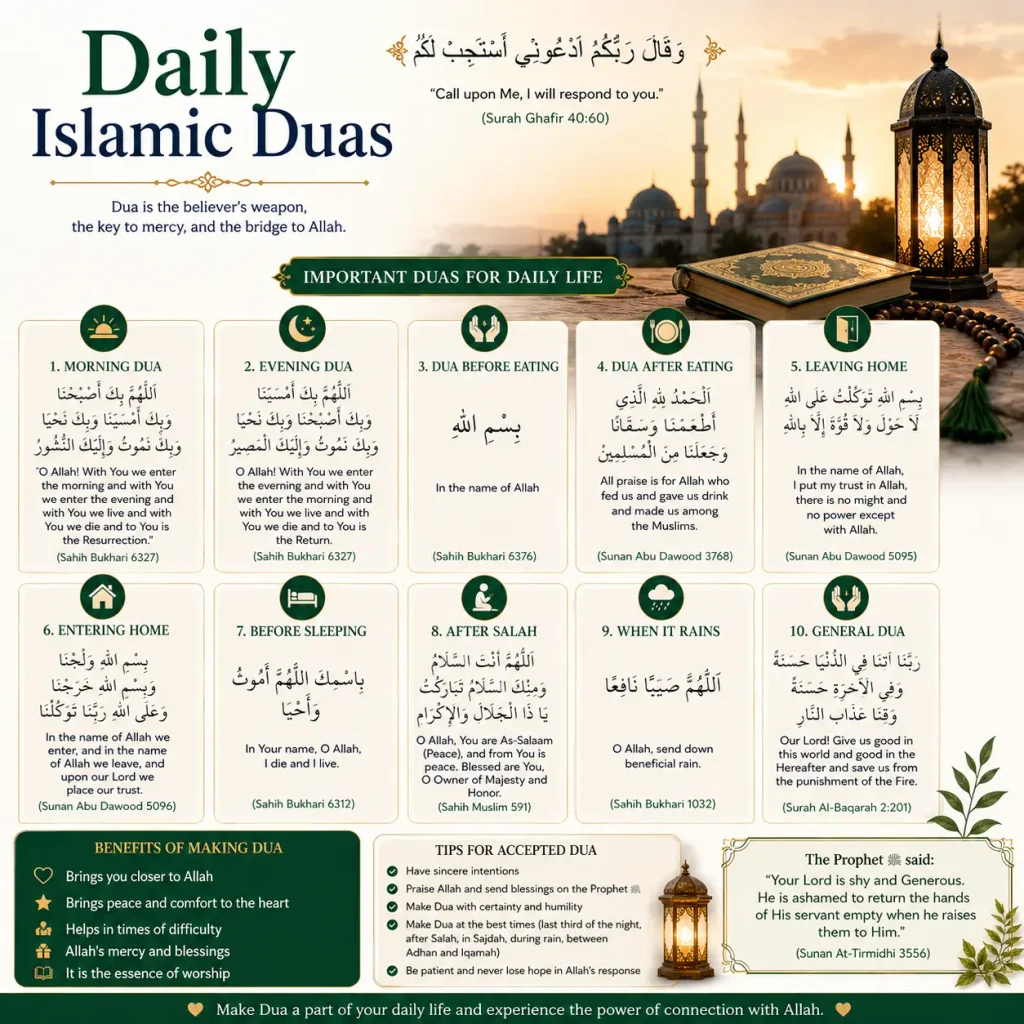
Morning Adhkar
Morning remembrance has a recognized place within daily worship. Keeping morning adhkar in their own section helps readers distinguish them from prayers intended for other periods.
For each entry, a dependable resource should ideally provide the Arabic wording, its meaning and the supporting reference.

Evening Adhkar
Evening remembrance can likewise be kept in a separate section. This makes the appropriate time easier to recognize and provides readers with a straightforward routine.
If a narration mentions a specific time or number of repetitions, that detail should be taken from the source rather than from an unverified website instruction.
Duas for Protection
Islamic teachings include supplications through which believers seek refuge and safety from harm. Protection-related remembrance is also a common category in contemporary dua resources.
Such information should be presented with care. A particular prayer should not be described as guaranteeing a worldly outcome unless that claim has reliable Islamic evidence.

Duas for Forgiveness
A believer can turn to Allah after making a mistake and seek His pardon and acceptance of repentance. Both the Quran and Sunnah contain established forms of asking for forgiveness.
When these prayers are published, their Arabic wording should be checked against the source. A translation or explanatory note should remain distinct from the original text.

Duas for Difficulties
Hardship may involve uncertainty, loss, fear or personal problems. During such circumstances, a believer can turn to Allah and ask for assistance, patience and a beneficial outcome.
Dua should not be described as a mechanical method that guarantees a particular result. It is an act of worship and a means of expressing reliance upon Allah.

Dua for Rizq
A Muslim may ask Allah for halal provision, blessing and contentment. Such supplication can be accompanied by lawful employment and responsible financial effort.
Relevant prayers can be placed within a dedicated provision section, allowing visitors to reach them without having to search through unrelated material.

Dua for Family
Supplications concerning family may include parents, children, spouses and descendants. The Quran contains prayers related to family and righteous offspring, and the Sunnah also includes relevant supplications.
Grouping these prayers with their references allows readers to understand both the wording and the context in which they appear.

Dua for Health
A person experiencing illness or weakness may ask Allah for healing, relief and strength. Such material should be presented carefully without turning a supplication into an unsupported medical claim.
Dua and medical care should not be treated as alternatives. A person may worship Allah through supplication while also seeking appropriate healthcare when necessary.

Travel Dua
The Sunnah contains established remembrance associated with travelling. Keeping travel-related material together makes it easier for someone to locate the relevant supplication before beginning a journey.
Many Islamic dua libraries also provide travel as a separate category, sometimes including prayers connected with riding a vehicle and returning home.
Duas Related to Salah
Certain supplications have a specific connection with Salah. These should be distinguished from prayers intended for ordinary daily circumstances.
A well-arranged resource can explain the context of each prayer and provide its reference instead of assuming that every commonly circulated supplication has the same status.
How to Learn Islamic Duas
There is no need to memorize a large collection immediately. It can be easier to begin with a few prayers connected with situations that occur regularly.
For each prayer:
- Read the Arabic accurately.
- Learn what it means.
- Locate its original source.
- Practice it consistently.
- Introduce another supplication once the earlier one is familiar.
This approach makes memorization easier while keeping understanding alongside the learning process.
Checking the Authenticity of a Dua
A prayer appearing online does not automatically mean that its source is established. Some websites provide references for individual entries, whereas others publish collections without identifying where particular wordings came from.
A Quranic supplication should be traceable to the Quran. A prayer attributed to the Prophet ﷺ should have an identifiable hadith reference. This distinction is particularly important when a resource describes its material as “authentic” or “Masnoon.”
Islamic Dua Categories
A comprehensive website can arrange its material according to different user needs:
Quranic Duas | Masnoon Duas | Morning Adhkar | Evening Adhkar | Salah | Sleep | Food | Travel | Protection | Forgiveness | Family | Rizq | Health | Difficulties
These sections address major search needs while avoiding the need to reproduce the same introductory explanation throughout the website.
Frequently Asked Questions
An Islamic Dua is a request directed towards Allah. A person may seek guidance, ask for forgiveness, request protection or turn to Allah for assistance with a lawful need.
They are supplications recorded in the Quran. Many are connected with prophets, while others appear as prayers for believers.
They are supplications associated with the Sunnah of Prophet Muhammad ﷺ and supported by Islamic source material.
A Muslim may ask Allah about personal needs using their own words. Established supplications from the Quran and Sunnah can also be learned and recited.
It is practical to begin with prayers related to frequent activities, such as waking, sleeping, eating, leaving home and travelling.
Locate the original source. Quranic wording should correspond to a Quranic passage, while a Prophetic supplication should have an appropriate hadith reference.
Explore Islamic Dua
A reliable Islamic Dua resource should give priority to accurate wording, dependable references and clear organization. The size of a collection alone does not determine its quality.
When Arabic text, translation, source and context are presented properly, readers can understand what they are reciting and why the particular supplication is connected with a given situation.