
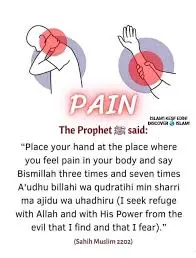
A painful body can make even simple tasks uncomfortable. For a Muslim, such a moment is also an opportunity to remember Allah and ask Him for help. Pain Dua in Islam
There is a specific Sunnah practice connected with bodily pain. It was taught by Prophet Muhammad ﷺ to Uthman ibn Abi al-As رضي الله عنه.
Pain Dua in Islam
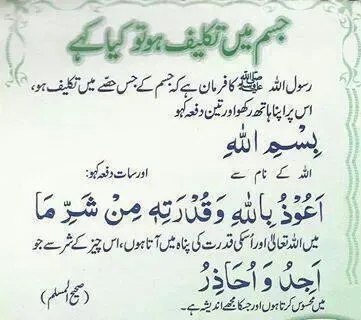
Put your hand on the place that hurts.
Read:
بِسْمِ اللَّهِ
3 times
Then read:
أَعُوذُ بِاللَّهِ وَقُدْرَتِهِ مِنْ شَرِّ مَا أَجِدُ وَأُحَاذِرُ
7 times
Meaning
“I seek refuge in Allah and His power from the harm of what I feel and what I fear.”
Where Does This Dua Come From? Pain Dua in Islam
This practice is reported in Sahih Muslim 2202.
Uthman ibn Abi al-As رضي الله عنه told the Prophet ﷺ about pain affecting his body. He was then shown what to do when experiencing it. The instruction involved touching the painful place and reciting the specified words.
Because the practice has a direct hadith source, it should not be mixed with unsupported formulas found on the internet.
- A Simple Way to Remember It
- Think of the practice as:
- Painful place → Bismillah × 3 → Dua × 7
There is no need to create a complicated routine around it.
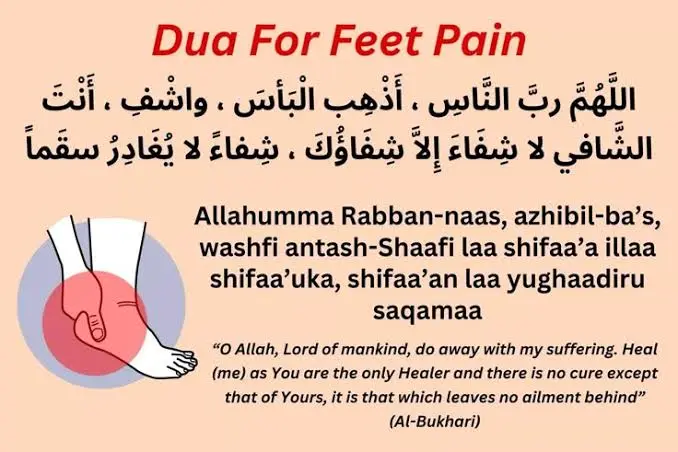
Can I Ask Allah for More?
- Certainly. A Muslim can also make a personal prayer asking Allah for comfort, recovery, strength, and wellbeing.
- If those words are one’s own dua, they should not be described as a quotation from the Prophet ﷺ unless there is evidence for that attribution.
Does It Cure an Illness?
- The hadith establishes a supplication associated with bodily pain. It does not identify the dua as a guaranteed cure for a named disease.
- Therefore, claims such as “this dua permanently cures every type of pain” should not be presented as Islamic fact.
What About Medicine?
- Reciting the supplication and obtaining medical care can go together.
- If the source of the pain is uncertain, or the discomfort continues or becomes serious, medical evaluation may be needed. Prayer should not be used as a reason to ignore symptoms that require attention.
FAQ
The reported supplication is: أَعُوذُ بِاللَّهِ وَقُدْرَتِهِ مِنْ شَرِّ مَا أَجِدُ وَأُحَاذِرُ It is part of the practice narrated in Sahih Muslim.
Bismillah is said three times. The main supplication is then repeated seven times.
Yes. The narration mentions placing the hand on the location of the pain.
Yes. The narration mentions placing the hand on the location of the pain.
Yes. You may ask Allah for relief using your own words, while keeping the Prophetic supplication distinct from personal prayers.
No. A persistent or severe physical problem may require professional medical assessment.
Final Reminder
The Prophetic guidance for bodily pain is short and easy to follow. Place your hand over the painful area, say Bismillah three times, and recite the reported supplication seven times.
The practice is documented in Sahih Muslim and can be followed while continuing to take sensible steps for one’s physical wellbeing.